Turkey Teeth Gone Wrong: What Really Happens — And How We Fix It
Every week, patients arrive at Soho Dental Clinic in a state of quiet desperation. Some have travelled from the UK, Germany, or the Netherlands. Some cannot eat. Some cannot sleep.
Some have been turned away by their own dentists back home. All of them had one thing in common: they went abroad for affordable dental work, and something went terribly wrong. This is not a story about condemning dental tourism. It is a story about what actually happens when implants fail — and what it takes to truly rescue a smile.
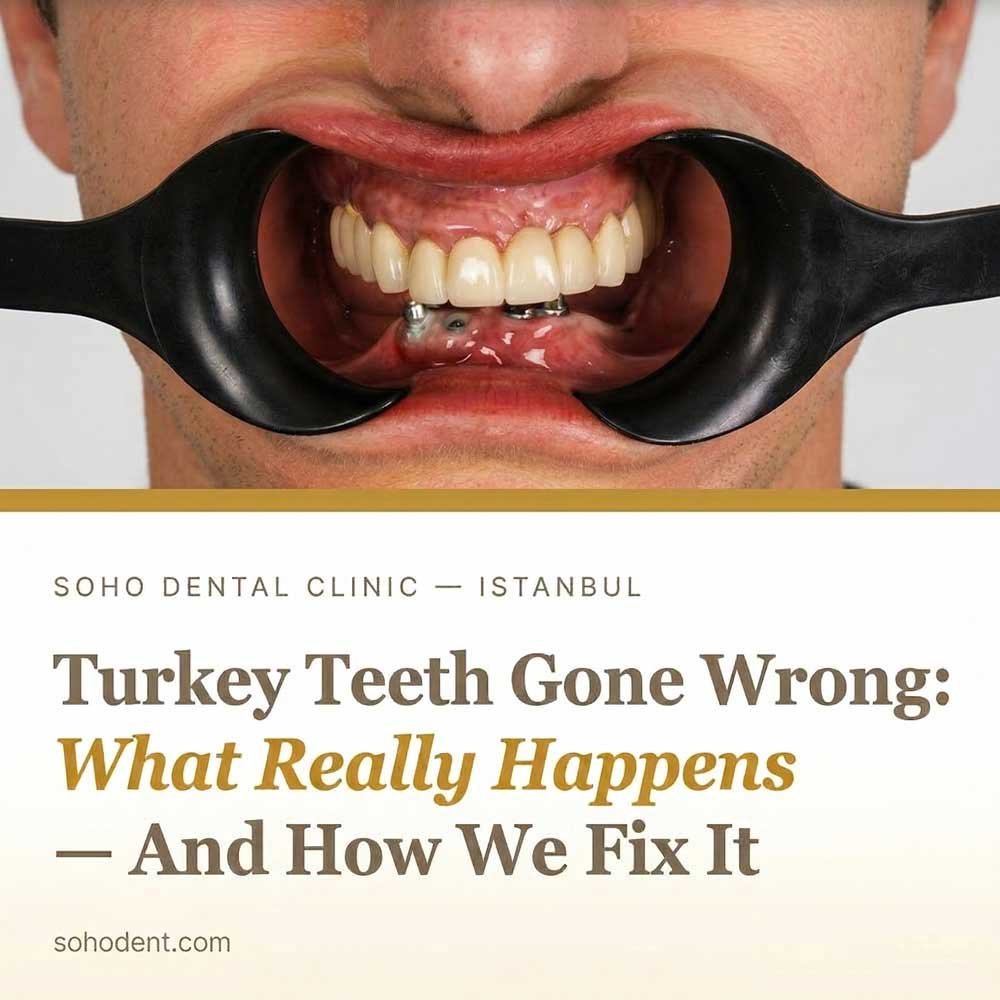
In a BBC News report from September 2025, a patient described how implant work in Antalya left her with a collapsed septum, unable to breathe through her nose. The NHS confirmed it cannot generally provide corrective treatment for complications from cosmetic procedures performed privately overseas. She has spent years and thousands of pounds trying to manage the damage. She is not alone.
| 400,000+ Patients treated in Turkish clinics per year (2023) | 3–5% Complication rate considered “acceptable” by Turkish dental associations | 9/10 UK dentists have treated complications from dental work done abroad (BDA, 2022) |
Behind those statistics are real people. And some of them end up in our clinic. What follows is an honest look at how dental implants fail, why revision surgery is so much harder than starting fresh, and what it means to choose a clinic that prioritises your long-term health — not just the lowest price on the invoice.
What Are “Turkey Teeth Gone Wrong” — And Why Is It Becoming a Crisis?
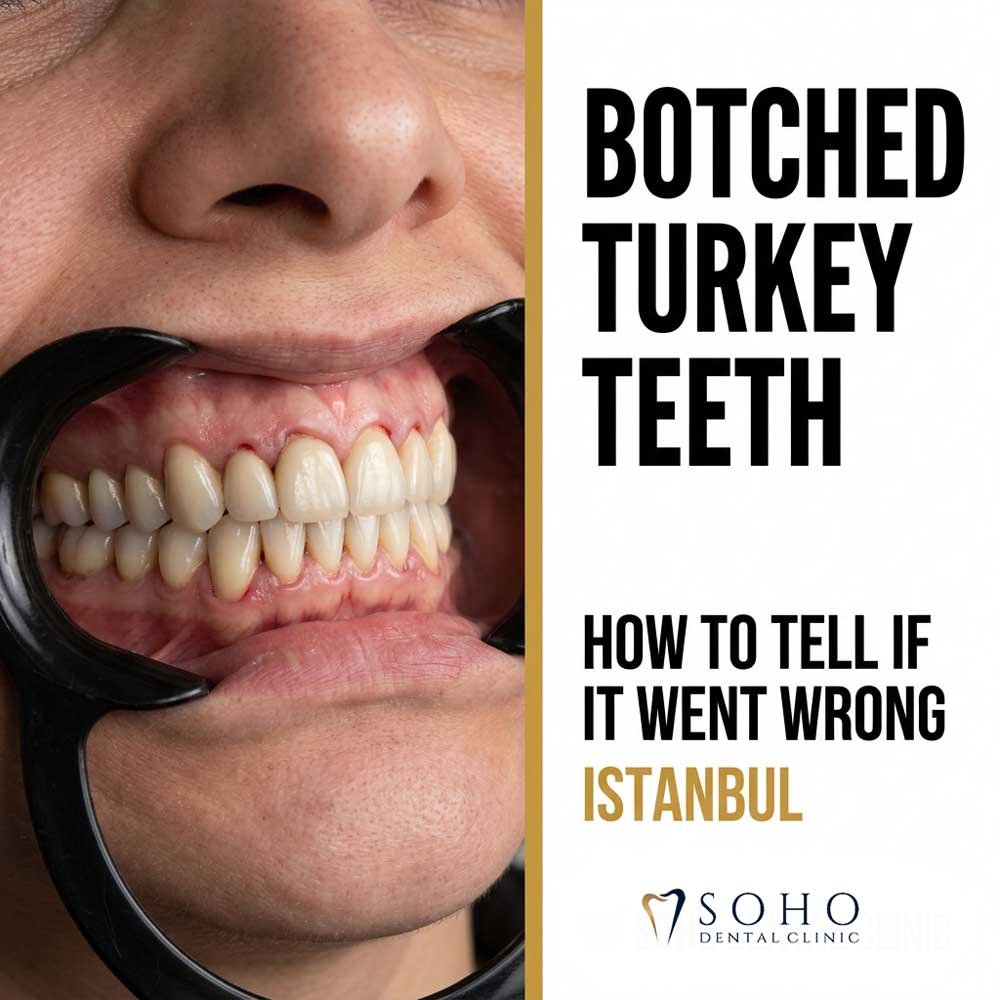
The term “turkey teeth” originally referred to the unnaturally uniform, porcelain-bright veneers that became popular among British tourists travelling to Turkey for cheap cosmetic dentistry. Social media amplified the trend dramatically. Influencers posted smiling before-and-after videos. Clinics advertised “Hollywood Smiles” for a fraction of UK prices. Thousands of people booked flights.
For many, the initial results looked good in photographs. But dentistry is not photography. A crown that looks white in a selfie can be improperly fitted, placed on a tooth shaved down to a peg, attached to an implant positioned at the wrong angle, or seated on bone that was never properly assessed. The problems that follow take months — sometimes years — to surface.
| ⚠ What UK dentists report: Implant brands used at many Turkish clinics are often not exported to the UK, meaning there are no compatible replacement parts if something needs adjusting. Most UK dentists decline to treat complications from overseas dental work due to liability concerns — leaving patients with nowhere to turn at home. |
The crisis is driven by a collision between genuinely lower costs (Turkey’s economic advantages are real), unregulated marketing, and the biological reality that complex surgical procedures cannot be safely compressed into a four-day package holiday.
The Most Common Ways Implants Fail Abroad
After performing hundreds of revision surgeries, we have seen every form of implant failure imaginable. The most common causes are not mysterious — they are predictable consequences of shortcuts taken during planning, surgery, or aftercare.
Incorrect All-on-4 Placement
All-on-4 is not simply “four implants.” It is a biomechanical system in which implants must be placed at precise angles — typically with the posterior implants tilted at 30 to 45 degrees — to distribute chewing forces across the full jaw arch. When four implants are placed side by side in the front of the jaw, every chewing action overloads those implants. The result is bone loss, screw fractures, and eventually, complete failure.
Connecting Implants to Natural Teeth
Natural teeth have a small, natural range of micro-movement within the jaw. Implants are fused rigidly to bone; they do not move at all. Connecting these two fundamentally different structures means that every time the patient chews, the mobile tooth and the immobile implant pull in opposite directions. Infection and bone loss are the inevitable result.
Skipped Healing Periods
Osseointegration — the process by which an implant fuses with the jawbone — takes three to six months. It cannot be accelerated. Clinics that place permanent prostheses immediately are gambling with a process that biology dictates on its own schedule. When it fails, the implant does not just loosen. It takes bone with it.
Inadequate Pre-Surgical Assessment
Every implant placement must be preceded by a 3D CBCT scan that maps bone density, nerve pathways, and sinus anatomy. Clinics that rely on basic panoramic X-rays — or no imaging at all — are operating blind. In the upper jaw particularly, implants placed without sinus lift assessment can perforate the sinus membrane, causing chronic infections that are extraordinarily difficult and expensive to treat.
Real Patient Stories: Implant Rescue at Soho Dental Clinic
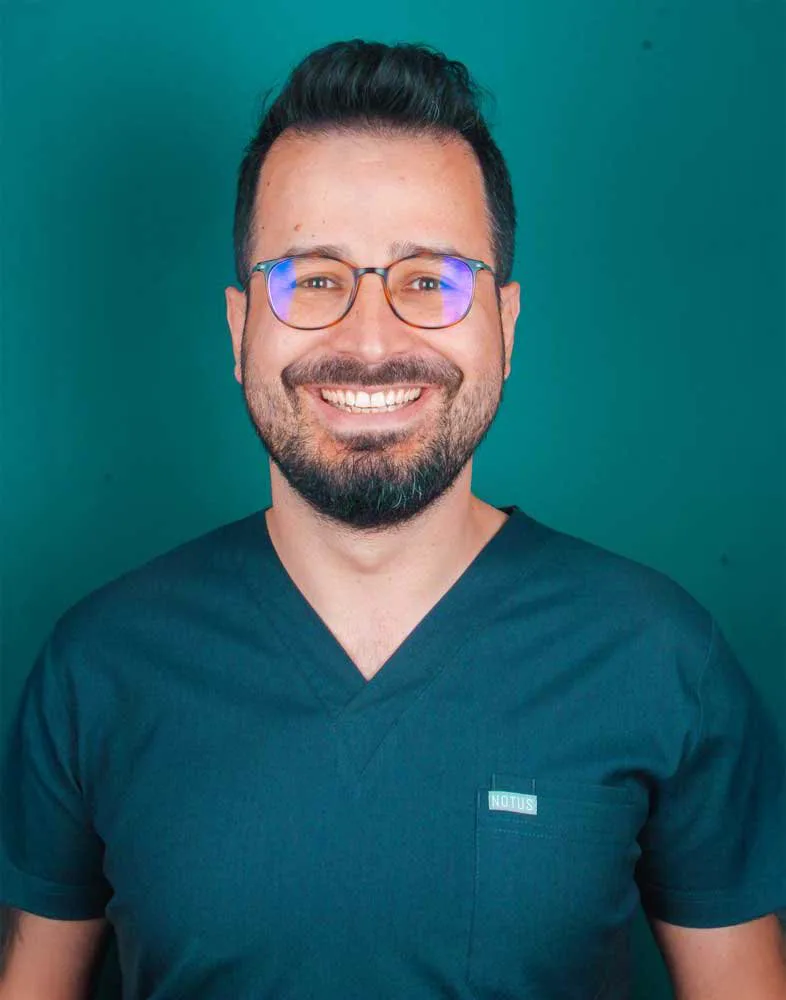
We do not ask patients to take our word for any of this. Dr. Utku Onur Yüksel, our specialist in implantology and periodontology, documents our revision cases in detail — because patients considering implant work deserve to understand what revision surgery actually looks like, and what it requires.
|
||
|
Two patients — a married couple — had implants placed elsewhere two years before coming to us. The wife had lost all six implants in her lower jaw and three in her upper jaw, with significant bone loss visible around every remaining fixture. The husband presented with six failed lower implants and three upper implants in similarly critical condition. When they arrived at our clinic, both were in acute distress. We performed revision surgery on the same day. By the following day, both patients had temporary teeth. They left two days later able to smile. |
| ▶ Watch: Case 1 — Full Mouth Implant Rescue (Nine Failed Implants) |
| Dr. Utku Onur Yüksel walks through the X-rays, the surgical approach, and the outcome for a couple whose implants failed entirely elsewhere. Watch the before-and-after imaging side by side. |
|
||
|
This case has particular meaning for us. The patient is Dr. Yüksel’s aunt, who lives in Germany. Two years before coming to us, she had All-on-4 treatment and veneers placed at a German dental clinic. Her complaints began exactly one year later: pain, inflammation, a crooked smile line, and prostheses literally separating from the implants beneath them. The X-rays told the full story. Four implants had been placed side by side in the front of the lower jaw — not at the angles that All-on-4 requires. One had bone loss, another a fractured screw, a third a fractured neck, and the fourth had separated from its prosthesis entirely. In the upper jaw, an implant had been connected to a natural tooth — one of the most serious errors we see. Surgery was completed in a single day. The following morning, she returned to Germany with fixed temporary teeth. After a three-month healing period the entire final treatment was completed in one week. |
| ▶ Watch: Case 2 — All-on-4 Rescue After One Year of Failure |
| Dr. Yüksel explains the exact biomechanical mistakes that caused the failure — and shows the X-ray comparison between the original placement and the corrected implant positions. |
| “We are not selling implants. We are performing surgery — with years of experience and with great care. When choosing a clinic, your goal should not be to buy a good brand implant at the cheapest price. It should be to find an experienced and trustworthy team capable of performing such delicate surgery.” — Dr. Utku Onur Yüksel, Specialist in Implantology & Periodontology, Soho Dental Clinic |
Why Is Soho Dental More Expensive Than Other Turkish Clinics?
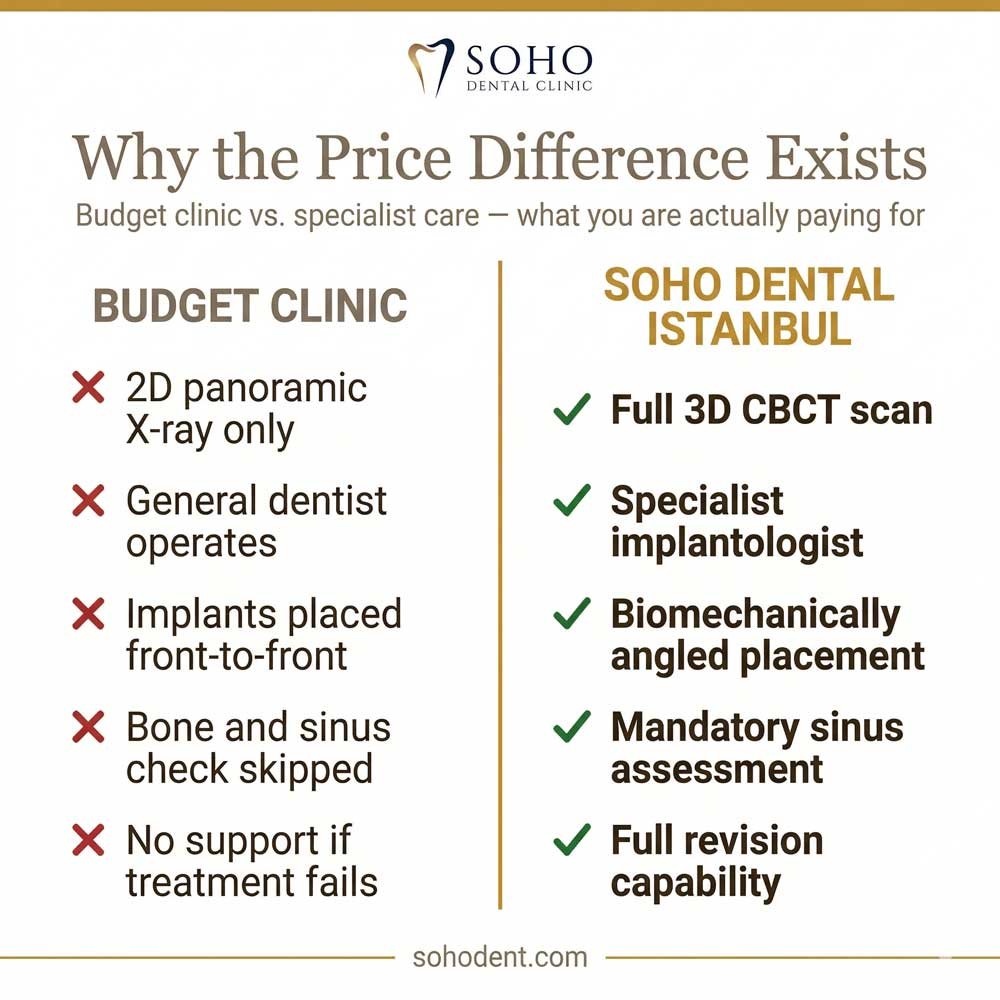
We are sometimes asked this directly, and we believe the question deserves a direct answer. Our prices are higher than many Turkish clinics. Here is why — and why we believe that is the right approach for any patient considering a procedure that will affect their health for the rest of their life.
| What you are paying for | Budget clinic | Soho Dental Istanbul |
|---|---|---|
| Pre-surgical imaging | Panoramic X-ray only (2D) | Full 3D CBCT scan + digital planning |
| Surgical specialist | General dentist performing implants | Dr. Yüksel — specialist in implantology & periodontology |
| All-on-4 protocol | 4 implants placed front-to-front | Biomechanically angled, nerve-proximity positioned |
| Bone & sinus assessment | Often skipped or estimated | Mandatory before every implant placement |
| Temporary teeth | Same-day permanent (healing skipped) | Custom temporaries; permanents after osseointegration |
| Complication management | Little recourse if things go wrong | Full revision capability — we fix what others cannot |
The cost of revision surgery is significantly higher than the cost of the original treatment done correctly. Patients who come to us for revision have already paid once. They are paying again. And the second procedure is technically far more demanding, because bone has been lost, anatomy has been altered, and the margin for error is narrower.
| Our philosophy: We are not selling implants. The implant itself is a commodity. What you are paying for is the surgical skill, the diagnostic precision, and the clinical judgment to place that implant correctly — to recognise complications before they become crises, and to make sound decisions when anatomy does not cooperate. |
What Is Revision Implant Surgery — And Can It Fix Your Failed Treatment?
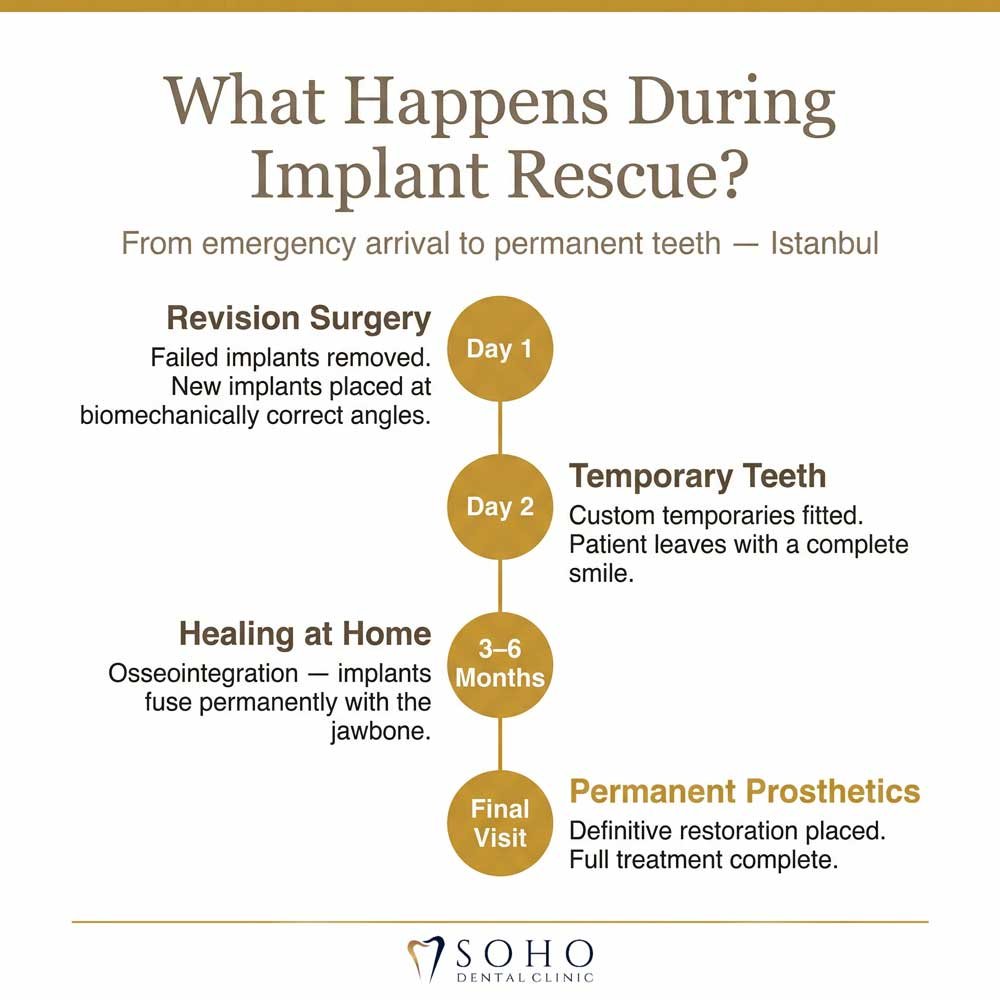
The short answer is: often yes, but the window of possibility closes over time. The longer answer depends on how much bone remains, what caused the failure, and what structures have been compromised.
When Revision Is Possible
If bone loss is present but not catastrophic, revision surgery can include bone augmentation followed by new implant placement at the correct positions and angles. In many cases, temporary teeth can be fitted the day after surgery, allowing patients to return home with full function within 48 to 72 hours of arrival.
When Revision Becomes More Complex
Sinus perforations, nerve involvement, and severe bone loss all increase the complexity of revision surgery. These are not reasons to give up — but they do require a specialist with specific training in reconstructive implantology and periodontal surgery.
The Revision Timeline
In straightforward revision cases, we complete the surgical phase in one day, fit temporary teeth the following day, and patients travel home on day two or three. After a three-to-six-month healing period, patients return for permanent prosthetics — typically three to seven additional days.
How to Avoid Turkey Teeth Gone Wrong: Red Flags to Watch For
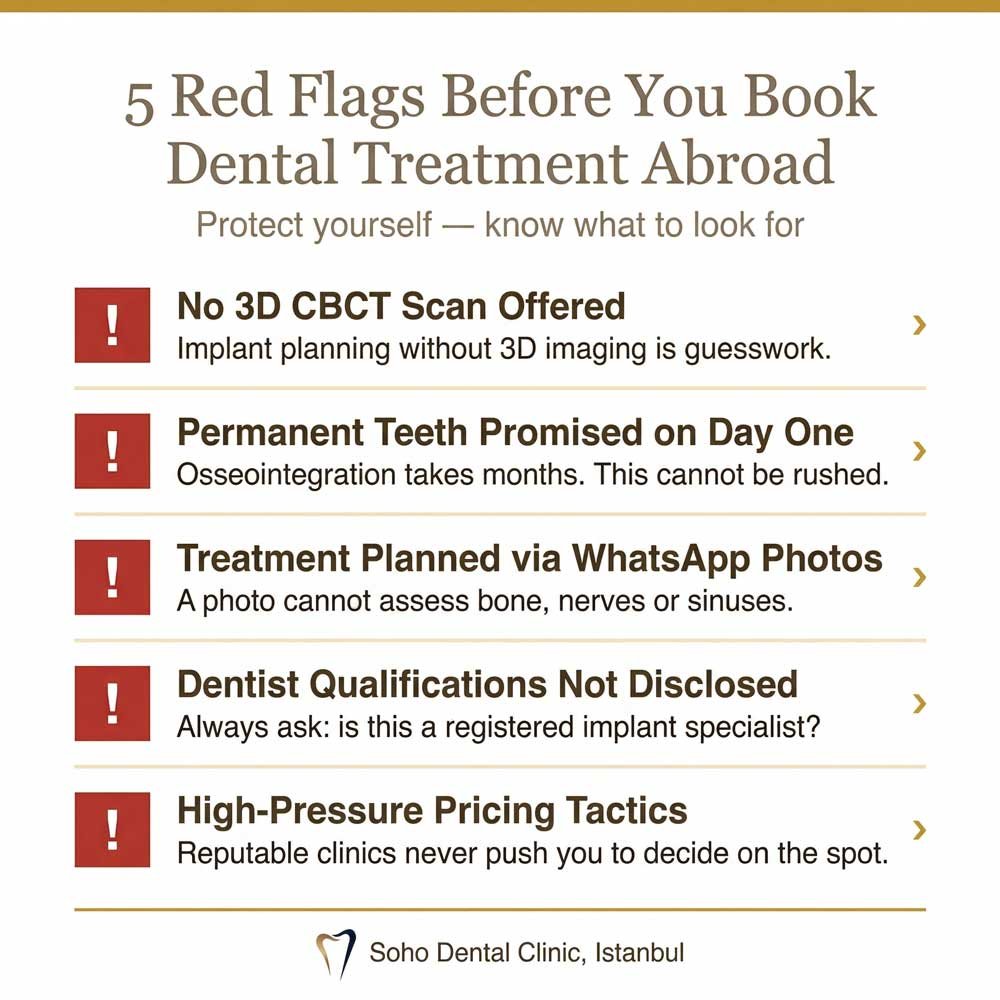
Not every Turkish dental clinic is a risk. Turkey has exceptional dentists, and Istanbul in particular has clinics that meet or exceed European standards. The problem is that the market is unregulated in the way that matters most to patients. Before you book, watch for these warning signs.
Is Soho Dental Worth the Extra Cost? What Our Patients Say
We believe the most honest answer comes from patients who have lived both sides of the experience: those who had treatment go wrong elsewhere and then came to us, and those who chose us from the beginning.
| “I arrived at Soho Dental in a state I would rather forget. Nine implants gone. I couldn’t eat properly. My own dentist in the UK wouldn’t touch me. Dr. Yüksel saw me the same day and operated within hours. Two days later I flew home with teeth. Months later I have my permanent ones. I wish I had come here first.” — Patient review, Soho Dental Istanbul |
We are a specialist clinic, not a volume business. We perform complex revision surgeries that most Istanbul clinics — and most clinics anywhere — decline. Our lead specialist, Dr. Utku Onur Yüksel, holds dual specialist qualifications in implantology and periodontology. Gum health and bone health are not afterthoughts in our approach — they are the foundation that every implant depends on.